Fine Antique C. 1880s Zsolnay Pécs Reticulated Floral Puzzle Jug
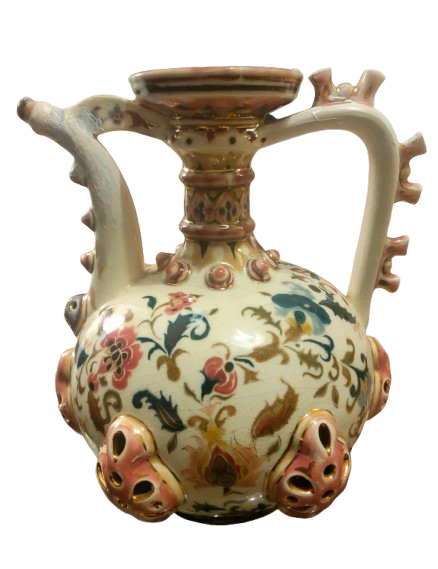

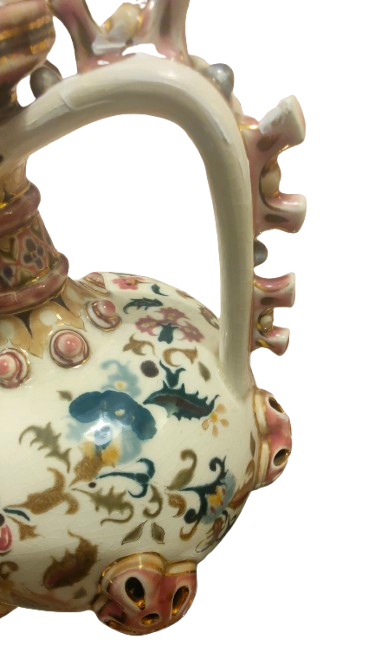

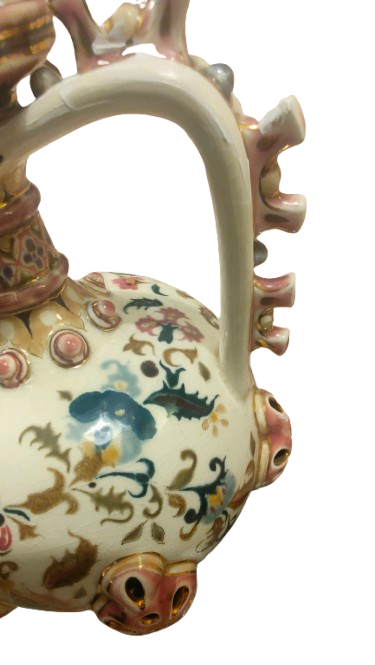

Headline: An exquisite late 19th-century Hungarian ceramic trick vessel featuring double-walled reticulated lattice work and hand-painted polychrome florals.
Key Specifications:
-
Maker: Zsolnay Pécs (Hungary)
-
Period: Circa 1880s (Austro-Hungarian Empire)
-
Dimensions: 9 in (Height) × 20 in (Circumference at widest point)
-
Item Code: S2B212030
-
Condition: Excellent antique condition with no cracks, fractures, or structural restorations.
Product Overview: Crafted during the peak artistic period of Hungarian ceramics, this late 19th-century Zsolnay Pécs Floral Reticulated Puzzle Jug showcases the factory's signature technical mastery. The piece features a double-walled earthenware body with meticulously hand-pierced reticulated lattice cutouts, adorned with vibrant hand-painted floral spray motifs inspired by traditional Hungarian folklore and Persian decorative art.
Designed as a classic novelty "puzzle jug," the vessel incorporates concealed internal channels and hollow handle spouts—requiring the drinker to solve the puzzle of covering specific holes to drink without spilling. This piece stands as both a decorative showpiece and a highly collectible work of 19th-century European art pottery.
The History & Legacy of Zsolnay Pécs
Founding & Industrial Rise (1853–1863) The company was founded in 1853 in Pécs, Hungary, by Miklós Zsolnay as a small stoneware manufacturer. In 1863, his son Vilmos Zsolnay took over management, shifting focus toward artistic experimentation, clay body engineering, and unique glaze formulations. Under Vilmos, Zsolnay transformed from a local workshop into an internationally celebrated ceramic house.
Golden Age & Technical Innovations During the late 19th century, Zsolnay achieved global acclaim through a series of key technical and artistic breakthroughs:
-
Reticulated Clay Construction (1880s): During the period this puzzle jug was produced, Zsolnay mastered double-walled, pierced lattice technique. Cutting intricate openwork into unfired porcelain-earthenware required extreme precision to prevent collapsing during firing.
-
The 1878 Paris World's Fair: Zsolnay won the coveted Grand Prix in Paris, establishing its reputation alongside European powerhouses like Sevres, Meissen, and Royal Doulton.
-
Eosin Glaze (1893): Developed alongside chemistry professor Vince Wartha, Zsolnay invented the famous Eosin glaze—an iridescent, metallic-luster technique (producing striking ruby, gold, and green sheens) that became a cornerstone of Hungarian Art Nouveau ceramics.
-
Pyrogranite Architectural Ceramics: The company developed frost-resistant architectural tiles that were used on landmark buildings throughout the Austro-Hungarian Empire, including Budapest's Matthias Church and the Hungarian Parliament.
Design Influence & Family Collaboration Vilmos Zsolnay operated the business as a creative family guild. His daughter Júlia Zsolnay and her husband, Polish architect and sculptor Tádé Sikorski, served as primary designers. They blended Central European folk patterns, Near Eastern motifs, and Japanese design principles, shaping the aesthetic identity of late 19th-century Hungarian Secessionist art.
By 1914, Zsolnay had grown into the largest manufacturing enterprise in Austria-Hungary. Today, 1880s Zsolnay reticulated pieces are featured in major decorative art museums, including the Victoria and Albert Museum in London and the Corning Museum of Glass.