Rare Dated 1961 Chinese Carved, Lacquered & Gilded Camphor Wood Hope Chest
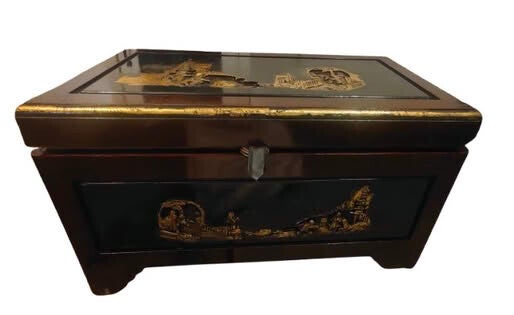
Rare Dated 1961 Chinese Carved, Lacquered & Gilded Camphor Wood Hope Chest
Description:
An exceptional and remarkably well-documented piece of mid-century oriental craftsmanship. Dated 1961, this impressive 4-foot Chinese hope chest is intricately hand-carved, lacquered, and accented with rich gilded highlights. Constructed from aromatic camphor and cedar wood, it features rare documented provenance—crafted by master carpenter Wu Fa and finished by painter/varnisher Zhao Long for the Xie Sheng Company.
Combining grand scale with practical storage, the natural camphor interior preserves stored linens and woollens with its signature protective aroma.
Key Features & Specifications:
-
Origin & Date: China, 1961 (Xie Sheng Company)
-
Artisans: Wu Fa (Carpenter) & Zhao Long (Painter / Varnisher)
-
Materials: Solid Aromatic Camphor Wood & Cedar Wood
-
Finish: Hand-Carved Relief, Deep Black/Dark Lacquer & Fine Gilded Detailing
-
Dimensions: 4 ft (L) x 2 ft (W) x 2 ft (H) (approx. 122 cm x 61 cm x 61 cm)
-
Storage Benefits: Naturally moth-proof and moisture-resistant interior
History of Camphor Wood Hope Chests
-
Natural Pest & Moisture Protection: Camphor wood (Cinnamomum camphora) contains natural aromatic oils that permanently repel moths, silverfish, and humidity. Historically, this made it the prized material across East Asia for storing delicate silk robes, woollen blankets, and valuable tapestries without needing artificial preservatives.
-
The "Hope Chest" & Dowry Tradition: Traditionally, these trunks served as dowry chests given to young women preparing for marriage. Throughout her youth, a bride-to-be would collect and store hand-embroidered linens, clothing, and household heirlooms inside her chest, taking it with her to her new home as a symbol of domestic readiness and status.
-
Export & Maritime Heritage: In the 19th and mid-20th centuries, camphor chests became immensely popular export items. Sailors, naval officers, and Western travellers trading in Hong Kong, Shanghai, and southern Chinese ports purchased them to transport spices, tea, and silks back home.
-
Symbolic Relief Carvings: The deep relief carvings typical of these chests are rarely purely decorative. Mid-century artisan workshops like the Xie Sheng Company frequently carved intricate scenes of maritime trade, courtyard leisure, dragons, or auspicious flowers (such as peonies and lotus blossoms) to represent wealth, longevity, and marital harmony.
- Shipping or collection: Contact to discus your options: